
· 5 min read · data · polymarket
Only 1 in 5 Polymarket traders ever turns a profit. We checked all 1.5 million wallets.
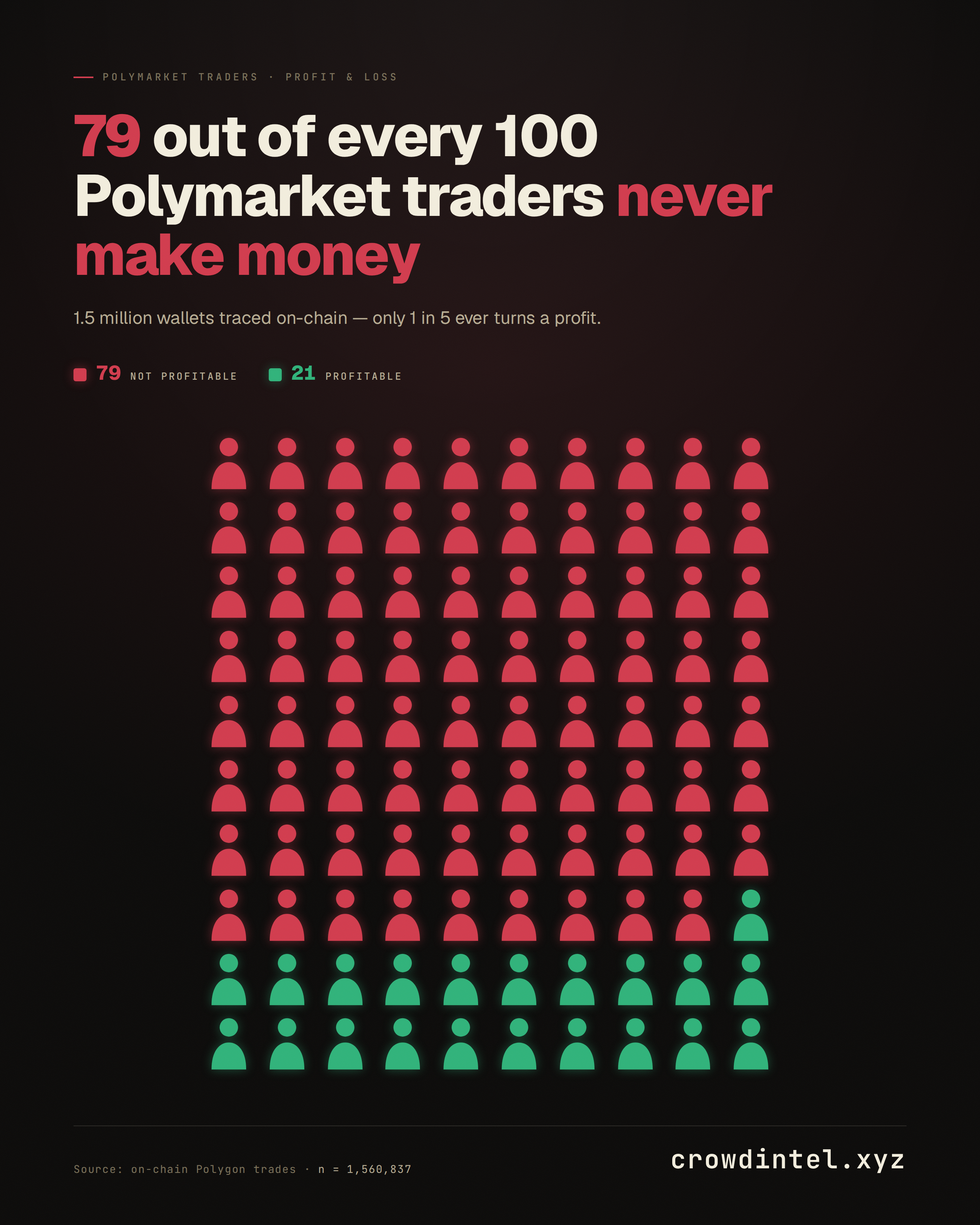
We aggregated realized P&L across 1,560,837 on-chain Polymarket wallets. Only 20.6% are net positive — the other ~79% never made money. Here's the full breakdown, how it lines up with the WSJ's findings, and where the winnings actually go.
By CrowdIntel · Updated
Prediction markets are sold as the place where being right pays. The pitch is seductive: do your homework, bet your conviction, beat the crowd. So we asked the only question that matters — across everyone who has actually traded on Polymarket, how many walked away with more than they put in?
We have the data to answer it directly. Not a sample, not a survey — every trade settled on-chain on Polygon, aggregated per wallet. The answer is brutal.
The breakdown
Here is the split, straight from aggregated wallet P&L. "Not profitable" means a wallet ended at break-even or a loss — it did not make money.
| Trader set | Wallets | Lost money | Broke even | Profitable |
|---|---|---|---|---|
| All wallets | 1,560,837 | 41.6% | 37.8% | 20.6% |
| Active traders (20+ resolved markets) | 27,060 | 62.3% | 0% | 37.7% |
Two honest readings live in that table:
- Across everyone, only ~1 in 5 is profitable. A huge slice — 37.8% — sits at almost exactly zero, the signature of accounts that placed a bet or two and stopped.
- Among people who actually played — 20+ resolved markets — the break-even crowd disappears and 62% are flat-out underwater. Filtering to serious participants doesn't rescue the average. It makes it worse.
Either way you cut it, the modal Polymarket outcome is not "small profit." It's "no profit."
Curious who the winners actually are? CrowdIntel tracks all 1.5M of these wallets live — the profitable ones ranked by real on-chain P&L, with their full track record. See the smart money — free →
This isn't just our data
We didn't stop at one number. We re-ran the exact question against our full on-chain ledger — then checked it against every independent study we could find. They all land in the same place.
Start with the hardest test: our own data, computed a second way. Our indexer holds 1.5 billion on-chain fills across 2.9 million wallets — every address that has ever touched a Polymarket contract, not a filtered sample. Reconcile each wallet's realized cashflow — what it put in versus what it pulled back out — and the verdict barely moves: only 23.3% are net positive. About 77% never pulled out more than they put in. Widen the net from the 1.56M wallets in our headline to all 2.9M and the answer holds — at best, 1 in 4.
And we're not the first to land here — independent datasets converge on the same story:
- A widely-cited analysis by on-chain researcher Andrey Sergeenkov covering 2.5 million wallets found 84% of traders lost money, with only ~2% accumulating more than $1,000 in profit.
- A separate study of 124 million trades found 70% were unprofitable.
- The Wall Street Journal's investigation into Polymarket and Kalshi concluded that almost everyone loses except a small group of professional traders.
That's five datasets, built by different people — two of them ours, from independent methods — all saying the same thing: most people lose. When the number won't move no matter how you compute it, it isn't a methodology artifact. It's the base rate.
Where the money actually goes
The flip side of "most people lose" is "a few people win big." The winnings on Polymarket are extraordinarily concentrated:
- The top 1% of accounts capture 76.5% of all gains.
- The top 0.1% — fewer than 2,000 traders — take home 67% of all profits.
- Only 840 accounts (0.033%) have cleared more than $100,000.
This is a power law, not a bell curve. The median trader isn't competing against other amateurs for a fair slice — they're feeding a tiny cohort of sharp, persistent, often-coordinated wallets. Identifying those wallets is the entire reason CrowdIntel exists.
Wanna see the wallets that take everything? The few hundred addresses capturing 76.5% of all profit are public and on-chain — we track every one in real time: what they're buying, what they're winning, and the funding clusters that link them. Watch the smart money live — free →
Methodology
Every wallet's realized P&L is aggregated from its on-chain Polymarket trades on Polygon. A wallet counts as "profitable" if its net realized P&L is greater than zero, "not profitable" otherwise. The all-wallet view includes every wallet with trade history; the active-trader view restricts to wallets with at least 20 resolved markets. P&L source of truth is each wallet's reconciled Polymarket figure, falling back to our computed total where Polymarket's isn't available.
Limitations
- Realized, not paper. Open positions aren't counted as wins or losses until they resolve. A wallet sitting on a large unrealized gain reads as break-even here.
- Wallets aren't people. One person can run many wallets; one wallet can be a shared or custodial address. "1.5 million wallets" is not "1.5 million humans."
- Break-even ≠ loss. We deliberately separate the two. The honest claim is "only 20.6% made money," not "79% lost money" — about half of that 79% ended near zero.
See it live
We built a live, always-current version of this chart that recomputes straight from on-chain data: crowdintel.xyz/loss.
If you'd rather study the 20% who do win, the profit leaderboard ranks them by real on-chain P&L, and the 3D galaxy shows the whole market at once — every wallet a star, green for profit, red for underwater, same-funder clusters pulled into bright knots. That's where the other side of this chart lives.
Running a fund or a quant desk? The same ledger behind every number on this page — 1.5 billion fills across 2.9 million wallets — is available raw: a read-only research workspace plus a REST API over the full dataset. That's Terminal, with founding pricing while it's new:
Wire the ledger into your model.
The CrowdIntel MCP server puts all 1.6B+ trades in your model — the exact tools Claude used in this post, in Claude Desktop, Cursor, or Zed. Free to test on any account — 20 calls a day, no card; the REST API is free to test too.
Don't be one of the 79%.
Most traders lose because they're flying blind. You don't have to. CrowdIntel reads every Polymarket trade on-chain and shows you, in real time:
- 🟢 Who's actually winning — the profitable wallets, ranked, with their full track record
- 🔭 Where the smart money is moving — live, in a 3D map of the whole market
- 🚨 Which wallets look like insiders — coordinated clusters and suspicious win streaks, flagged as they happen
Look up any Polymarket wallet's full P&L, or watch the 0.1% move in real time.
Start tracking the smart money — free →
No card, free during beta. The 79% don't know what they don't know — be in the 20% that does.